

The National Plant Phenotyping Infrastructure (NaPPI) was established to overcome the challenges in linking genotypes to phenotypes in fundamental and applied plant research. In this role NaPPI is advancing state-of-the-art Finnish plant science by providing access to specialized imaging instruments for monitoring plant growth, morphology and physiology, such as leaf temperature, spectral profiling and photosynthesis. NaPPI is a distributed research infrastructure currently with two nodes at UH and UEF that have complementing activities allowing wide range of phenotyping services to the research community across the country. NaPPI nodes offer access to high-throughput plant phenomics and to high precision spectral imaging and molecular omics platforms. In combination with the phenomics facilities and access to metabolomics services, the NaPPI installations provide a step towards bridging the gaps between whole-plant phenotypes of growth, development and physiology with integrated molecular profiles. By participating in phenomics data standardization efforts at the Nordic and European level, NaPPI is promoting technologies required for open scientific data in plant sciences. Following FAIR data standards has allowed NaPPI to engage in development of integrated HTPP crop modeling.
Contact details
Platform Chair
Professor Pirjo Mäkelä
pirjo.makela@helsinki.fi
Platform Vice Chair
Professor Markku Keinänen
markku.keinanen@uef.fi
Research Coordinator
Dr Kristiina Himanen
kristiina.himanen@helsinki.fi
Nodes
| Node/Host University | Node PI |
|---|---|
| UH NaPPI, UH | Kristiina Himanen, UH kristiina.himanen@helsinki.fi |
| UEF NaPPI, UEF | Markku Keinänen, UEF markku.keinanen@uef.fi |
UEF: University of Eastern Finland; UH: University of Helsinki
Services
The University of Helsinki (UH) NaPPI node has automated high-throughput plant phenotyping (HTPP) facilities housing multiple RGBs, thermal imaging set-up and two chlorophyll fluorescence imaging units (Imaging PAMs). The systems are available for small model plants (Compact system) as well as for large crop plants (Modular system), with capacities for 360 and 270 plants, respectively. Automation of the plant management and movement to watering and imaging stations allows programming frequent actions thereby providing systematic data collection following plant performance. While HTPP generates large amounts of data, UH NaPPI has engaged with Phenomics data management utilizing the PHIS information system.
At the University of Eastern Finland UEF NaPPI node has a wide range of specialized imaging instruments available at its Spectromics laboratory. The UEF NaPPI node houses five hyperspectral cameras covering the wavelength range from UV to midwave IR (250 – 5500 nm), liquid- cooled UV-optimized CCD (200 – 900 nm) and EMCCD cameras, light sources for fluorescence macroscopy, e.g. deep-UV LEDs, powerful and tunable narrowband light source, and three imaging PAMs. As part of the Academy of Finland’s Flagship programme on Photonics Research and Innovation (PREIN) and the UEF Center of Photonics Sciences the instrumentation of the UEF Computational Spectral Imaging group as well as their expertise in computational approaches is available for plant phenotyping purposes.Recent user publications
Coathup M, Mouhu K, Himanen K, Turnbull C, Savolainen V. 2024. Ecological speciation in sympatric palms: 5. Evidence for pleiotropic speciation genes using gene knockout and high-throughput phenotyping. Evolutionary Journal of the Linnean Society, 3 kzae017. https://doi.org/10.1093/evolinnean/kzae017
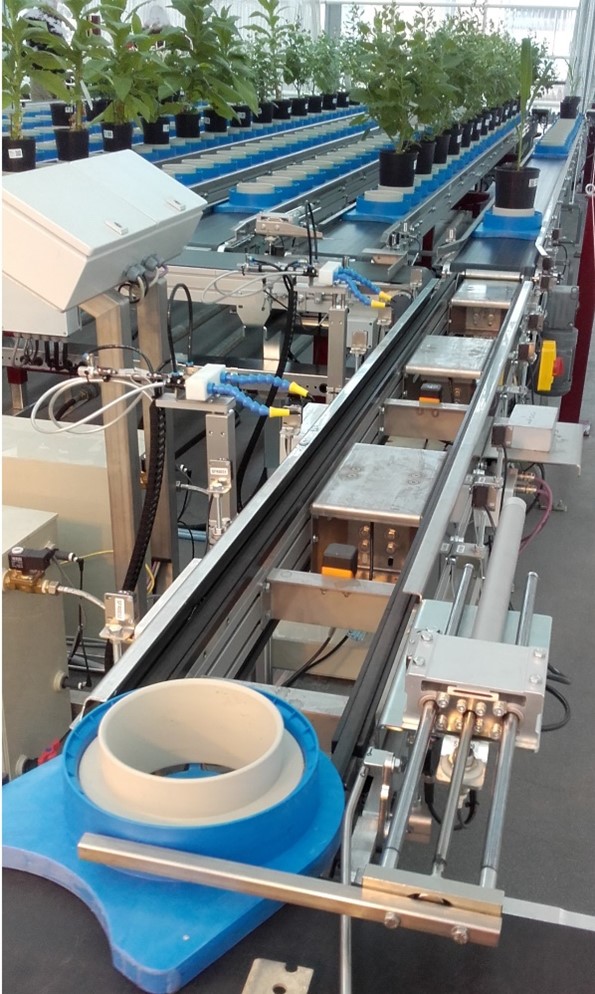
Large UH NaPPI facility with trays and plants travelling autonomously between watering
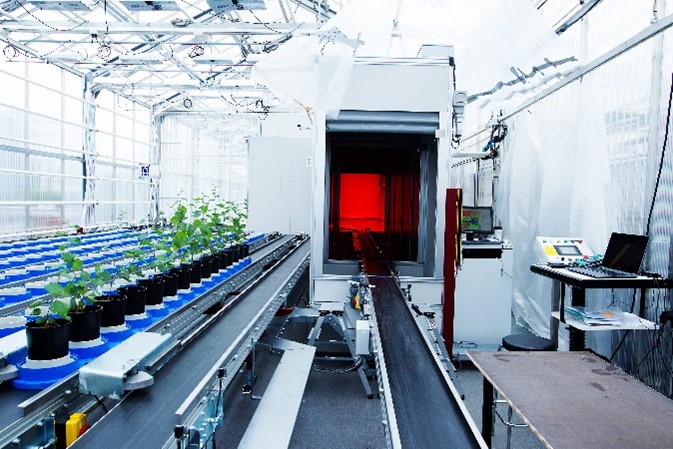
Imaging stations
